Link Search Menu Expand Document

Employee Groups

To improve employee management and effectively control item expenditure, operators are allowed to organize employees into groups and set value-based or transaction-based usage rules for each group. Limits can be applied on a daily, weekday, weekly, monthly or yearly basis.

Key Concepts

  • Value-Based Usage Restriction

To enable value-based restriction, first go to the Products page and add a value for each product. (Please note that the currency configuration can be customized in the Organization settings to align with your local standards. )

When the value-based limit is enabled, the system calculates the total value of the products each employee in this group has taken. Once an employee reaches the specified maximum, that employee’s access to additional products will be restricted until the next cycle.

The total is calculated from each product’s current value, not the value that applied when the item was taken. Changing a product’s value therefore immediately re-values everything an employee has already taken in the current cycle, and can push them over their limit retroactively. See Product Value Is Not a Price Snapshot before re-pricing a product mid-cycle.

  • Transaction-Based Usage Restriction

When the transaction-based limit is enabled, once an employee reaches the set limit on the number of products taken, that employee will be unable to retrieve any further products until the next cycle renews.

How Limits Are Evaluated

Understanding exactly how a limit is applied avoids surprises when you configure one.

Limits are an inclusive cap

The number you enter is the most an employee may take within the cycle — they may reach it, but not exceed it. The check performed before each dispense is “would this pickup take the running total past the limit?”. If so, the pickup is refused.

For example, a Transaction limit of 2 per week means an employee may take 2 items in the week; the 3rd pickup is refused until the next cycle begins. The same applies to Value limits (e.g. a $20 weekly limit allows pickups up to and including $20 of value, and refuses the one that would push the total over $20).

Limits apply across all products, per employee

A group limit is an aggregate over everything the employee takes, regardless of which product or which machine. It is not a per-product limit. (If you need a cap on a single specific product, use Product Restrictions instead.) Each employee in the group is measured individually — the limit is not shared across the group.

Only successful pickups count

The running total is built from completed pickups only. Failed dispenses, cancelled orders, and returns do not count toward a limit. A pickup that is still in progress at the machine has not been counted yet — it joins the total once the item is successfully dispensed.

  • Transaction limits count the quantity of items taken.
  • Value limits add up each item’s current Product Value multiplied by the quantity. Because the current value is used, re-pricing a product mid-cycle retroactively changes the total — see Product Value Is Not a Price Snapshot.

Employees who are not in a group fall back to the default group

Group limits reach an employee through their group membership. An employee who has not been assigned to a group is measured against the group you have marked as your organisation’s default group instead.

If no group is marked as the default, such an employee is not covered by any group limit at all and can take items without a value or transaction cap. If you rely on limits to control spend, either mark a default group or check that every employee who should be capped is actually assigned to a group — a new employee added later is unassigned until you set their group.

Changing a product’s value re-values the current cycle

This is the one behaviour worth reading twice, because it can cost an employee their allowance for spending they never did.

A Value limit is measured against each product’s value as it stands right now, not the value that applied on the day the item was taken. Nothing is copied onto the transaction at pickup time, so the moment you save a new value on the Products page, every pickup of that product in the current cycle is re-counted at the new figure — for every employee, immediately, with no warning on the Products page.

For example, with a $400 monthly limit and a headset originally valued at $300:

  Headset value Employee’s counted spend Remaining allowance
Employee takes one headset on the 3rd $300 $300 $100
You raise the value to $350 on the 10th $350 $350 $50
You drop the value to $200 on the 10th $200 $200 $200

The employee took exactly one headset in every row, but their remaining allowance moved each time you saved a new value. A large enough increase can put someone over their limit and block them for the rest of the cycle; a decrease quietly hands budget back.

Two practical consequences:

  • Time value changes to a cycle boundary where you can. Re-pricing on the 1st of the month (for a Monthly limit) or on a Monday (for a Weekly limit) means only the new cycle is affected.
  • A correction to a mis-typed value is not neutral. Fixing a product entered as $30 instead of $300 will immediately consume the allowance of everyone who took it this cycle.

Re-valuing is not limited to usage limits: your transaction reports and exports are re-valued the same way — see Product Value Is Not a Price Snapshot. No money changes hands in either case, so the consequence that bites is this one — who is allowed to take what.

Cycles are calendar-aligned, not rolling

Each cycle resets at a fixed calendar boundary in your organisation’s configured timezone, rather than looking back a rolling window:

Limit Cycle resets at
Daily The start of each calendar day (00:00)
Weekly The start of the week — Monday 00:00
Monthly The 1st of the month, 00:00
Yearly 1 January, 00:00

So a weekly limit refreshes every Monday morning regardless of when items were taken during the previous week — it is not “the last 7 days”. The same is true of the yearly limit: it is the calendar year, not “the last 12 months”. An employee who takes an item in December has a full allowance again in January.

If you are moving from a Product Restriction with a one-year inspection period, this is a real change in behaviour. A product restriction looks back a rolling window from each pickup (“365 days since your last one”); a yearly group limit resets on a fixed date for everybody. Someone who takes an item on 20 December can take another on 2 January.

A yearly limit is a good fit for high-value items — but pick the right one

The Yearly cycle exists for items an employee should only receive once or twice a year: a headset, a jacket, a pair of prescription safety glasses. Two ways to express that, and they behave differently:

  • Yearly Amount Limit — a spend budget for the year. A £300 headset against a £350 yearly budget leaves no room for a second one, while still allowing small consumables. This is usually the one you want.
  • Yearly Transaction Limit — a count of items of any product. Setting it to 1 means the employee may take one item of anything all year, not one headset — their first pair of gloves in January would use it up.

If you need a cap on one specific product regardless of group, use a Product Restriction instead. Group limits and product restrictions both apply, and the most restrictive one wins.

Because the yearly window is twelve months long, the re-valuation behaviour described in Changing a product’s value re-values the current cycle has much further to reach. A price change in June re-values everything taken since 1 January, for every employee, at once. Time yearly re-pricing carefully.

Weekday limits are per day of the week

The weekday boxes (Monday … Sunday) are independent daily caps that apply only on that named day. For instance, setting Monday to Friday to 2 gives each of those five days its own 2-item allowance (measured against that day’s total), while leaving Saturday and Sunday unrestricted. A weekday limit is evaluated against the same day-long window as the Daily limit.

The Default Group

An employee who has not been put in any group is covered by none of your limits, as described in Employees who are not in a group fall back to the default group above — they can take as much as they like, with no value or transaction cap at all.

That is easy to miss, because employees arrive without a group in several ways that never pass across an admin’s desk:

  • an admin adds an employee and leaves the Group field blank
  • an employee is added by CSV import with no group column filled in
  • an employee signs themselves up through self-service onboarding
  • an employee is created automatically by a ServiceNow sync
  • a temporary employee is issued an access code

Marking one group as the default closes that gap. Employees who are not in a group are given the default group’s limits, so your baseline policy applies to everybody by default and specific groups become the exceptions you make deliberately.

To set it, tick Use as the default group for this organization when creating or editing a group. The group holding it is marked Default in the group list. Only one group can be the default, so ticking the box on a second group takes it off the first.

Setting a default is immediate and retrospective. Everyone who is not in a group is measured against the default group’s limits straight away, counting from the start of the current cycle — so an employee who has already taken items today can find themselves over a daily limit the moment you save. Pick a cycle boundary to switch it on if that matters to you.

An employee who is in a group is governed by that group only. The default is a fallback, not an extra layer, and the two never stack.

If no group is marked as the default, nothing changes from before: employees without a group have no limits, and the group list tells you so.

Create a New Group

To create a new group, please follow this procedure:

  1. Visit the Employee Groups page
  2. Click the Create New Group button in the top right corner
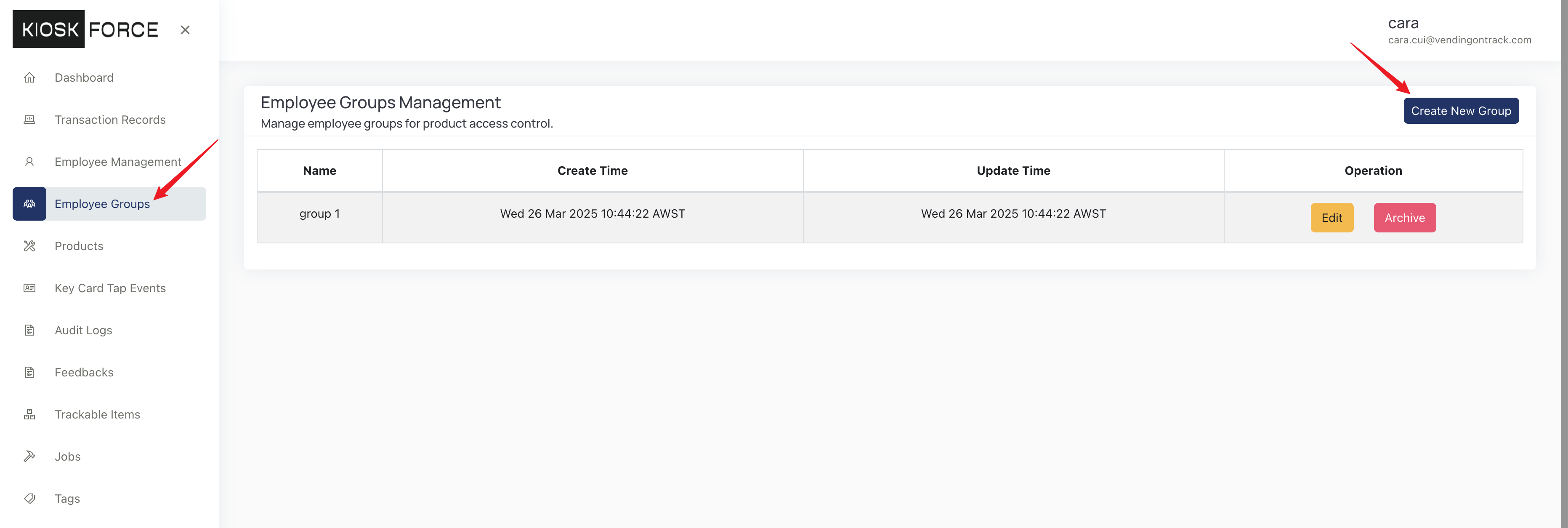
create_new_group

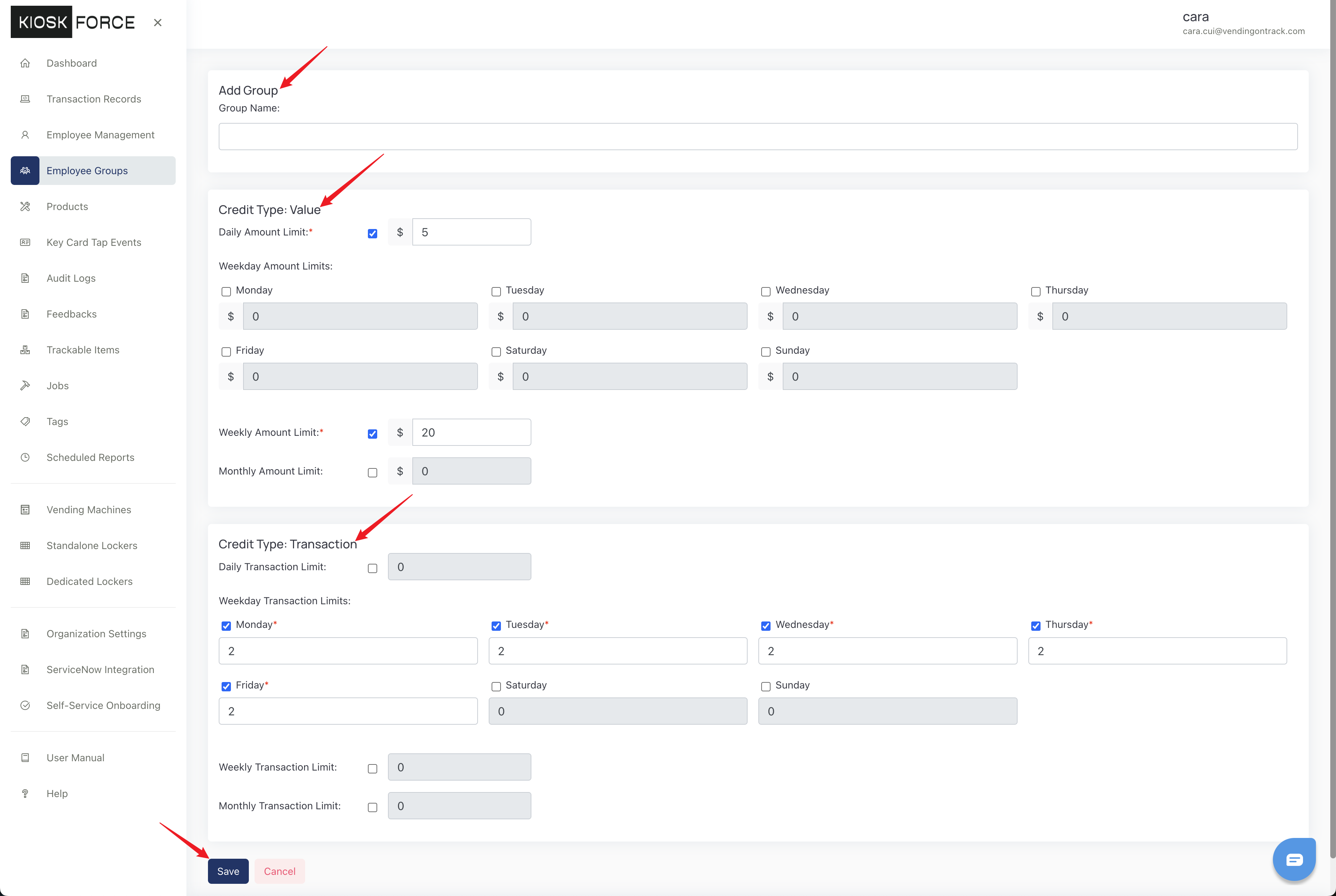
  1. Input the group name. If this group is to cover everyone who has not been put in a group, tick Use as the default group for this organization — see The Default Group.
  2. In the Credit Type: Value section, you can set a daily, weekday, weekly, monthly or yearly amount limit for this group. For example, to set a 5-dollar daily limit for employees in this group, check the Daily Amount Limit box, and enter the number 5; To set a 20-dollar weekly limit, check the Weekly Amount Limit box and enter 20.
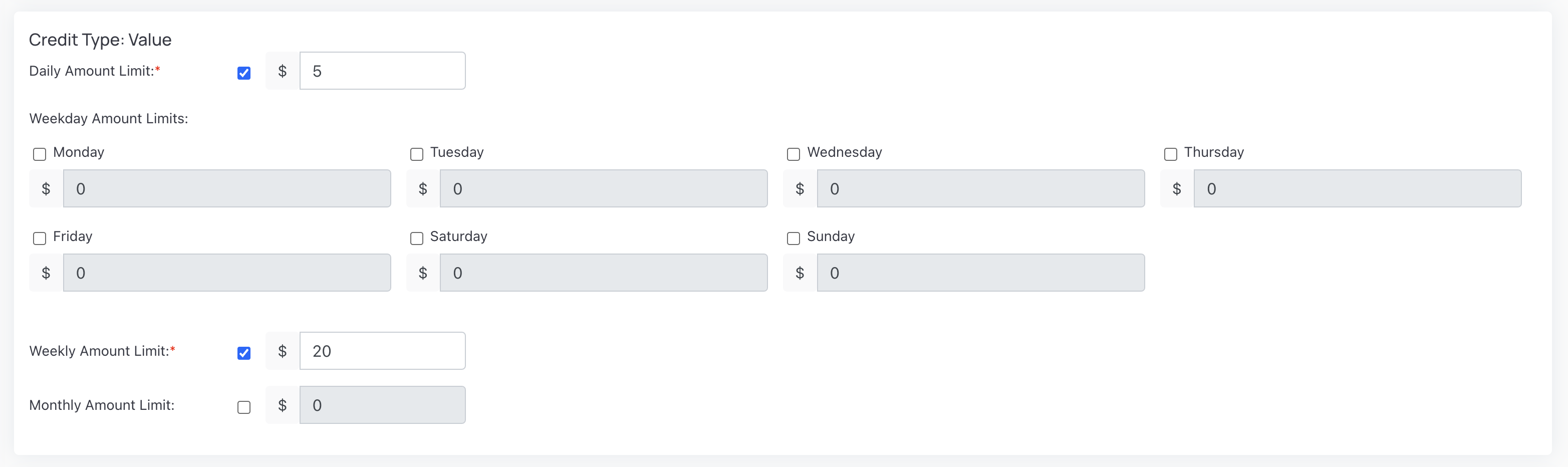
credit_type-value

  1. In the Credit Type: Transaction section, you can set a daily, weekday, weekly, monthly or yearly quantity limit for this group. For example, to set a 2-item daily limit from Monday to Friday, check the boxes from Monday to Friday, and enter the number 2 respectively.
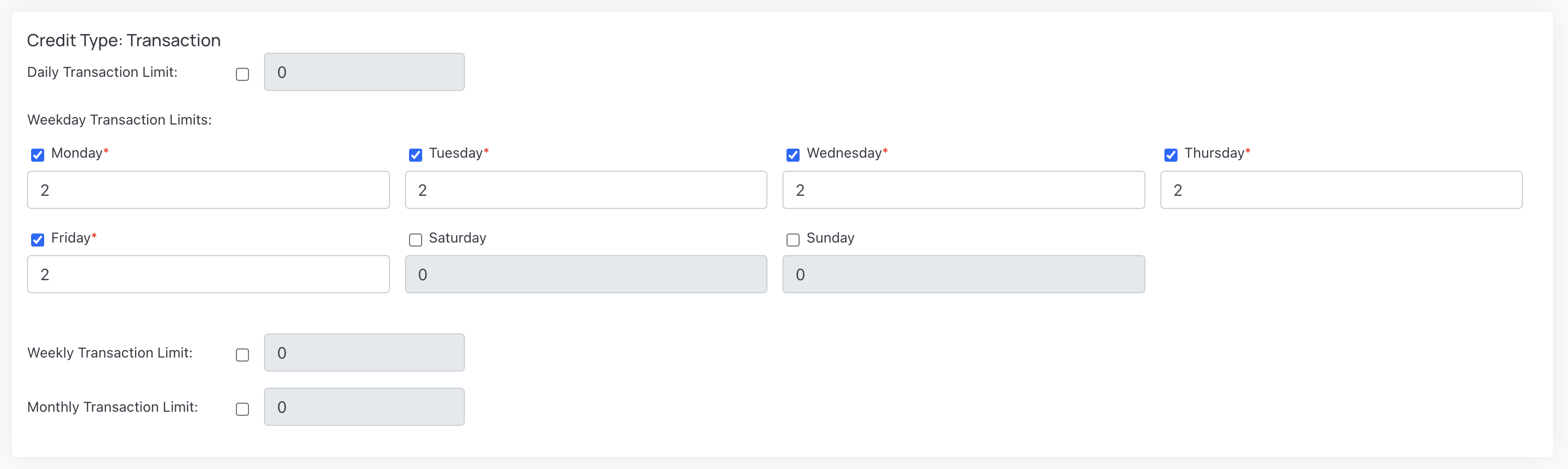
credit_type-transaction

  1. Click Save to put the rules into effect.
save_new_group

Assign Employees to Specific Groups

After saving the group rules, please follow this procedure to assign employees to a specific group:

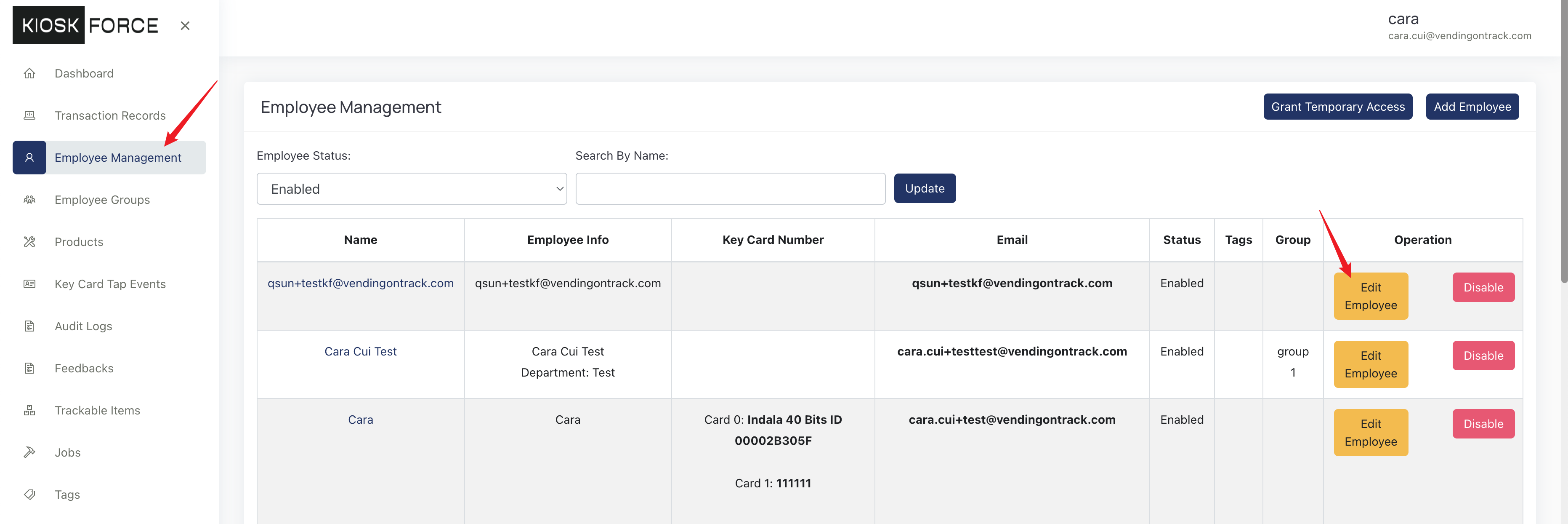
  1. Go to the Employee Management page
  2. Find the employee and click the Edit Employee button in the Operation column
  3. In the pop-up window, select a group for the employee
  4. Click Save.

edit_employee

save_employee_group

Update / Delete Employee Group

In the Operation column, click Edit to update group name or credit rules; click Archive to delete the group.

update_or_delete_group

A group cannot be archived while employees are still assigned to it — move them to another group first.

The default group cannot be archived at all while it holds that role, because archiving it would silently lift your baseline limits off every employee who is not in a group. Make another group the default, or untick the box, and then archive it.


Copyright © 2020–2026 Vending on Track Pty Ltd